
Digital twins and facility management meet at handover, and that is where most twin projects in Saudi Arabia succeed or fail. If the building arrives with a verified model and clean asset data, connecting it to sensors and maintenance systems is straightforward. If it arrives with drawings and a box of manuals, the twin starts with months of data collection.
What is a digital twin?
DefinitionThe Gemini Principles, published by the Centre for Digital Built Britain in 2018, define a digital twin as "a realistic digital representation of something physical", and add that what distinguishes it from any other digital model "is its connection to the physical twin".
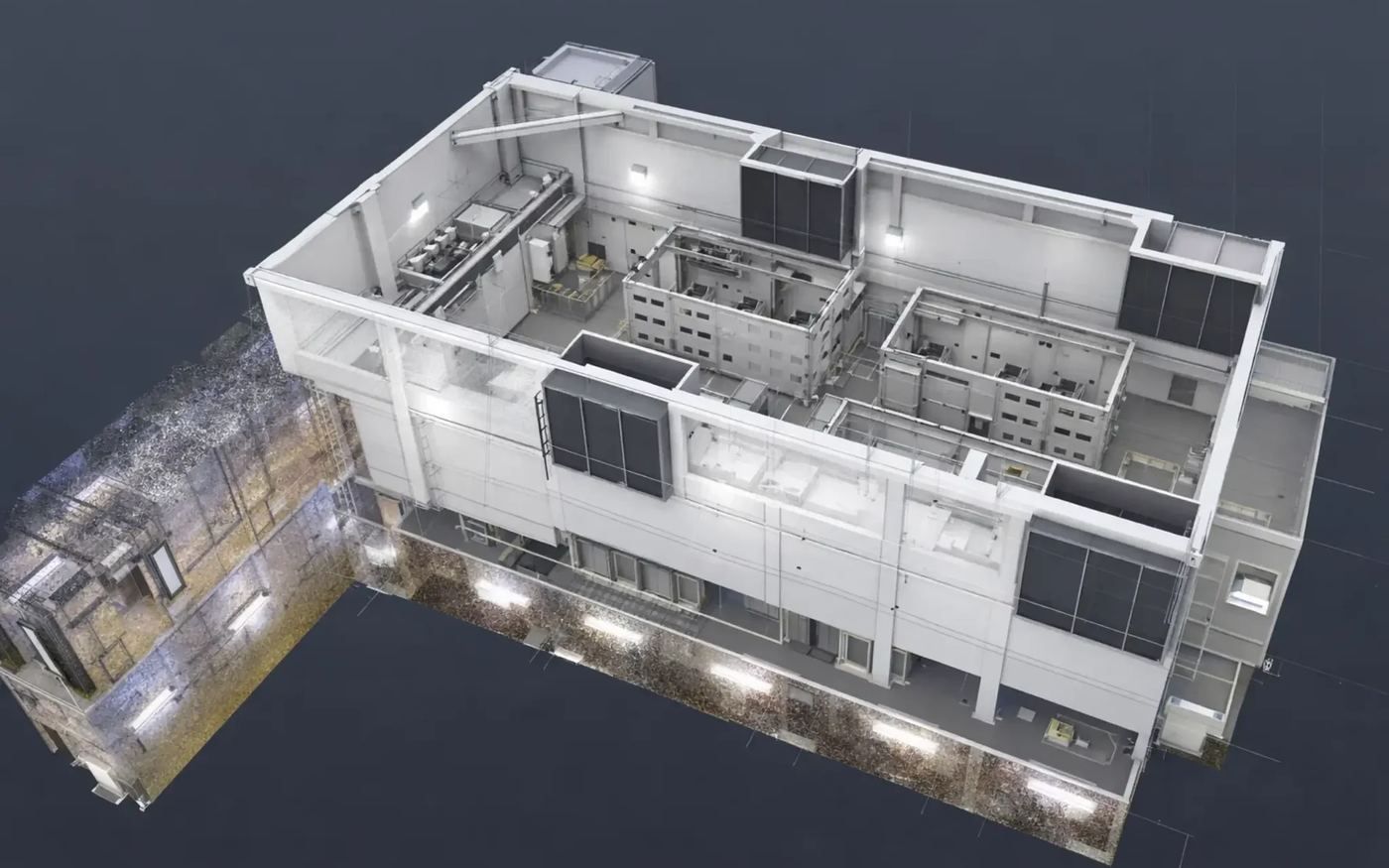
That connection is the point. A BIM model records the building as designed or built. A twin receives data from the building, such as energy use, temperatures, equipment status and work orders, and lets people make decisions with it. The Digital Twin Consortium's definition makes the same point when it describes a twin as synchronised with the real thing at a specified frequency and fidelity.
Who is using digital twins in Saudi Arabia?
Several public examples show the range, from single communities to whole cities:
- Cities. KED Global reported in July 2024 that the Ministry of Municipal and Rural Affairs and Housing, the National Housing Company and Korea's Naver launched a digital twin platform project covering Riyadh, Medina, Jeddah, Dammam and Mecca, for uses including infrastructure planning and simulating natural disasters.
- Communities. Arab News reported in April 2023 that ROSHN had linked its BIM to computer-aided facility management and asset registers, so it can identify each pipe, valve and junction box.
- Destinations. At LEAP 2026, stc Group's iot squared showed a platform for Red Sea Global that monitors Shura Island and Turtle Bay in real time across 10 square kilometres.
- Entertainment cities. A Qiddiya Investment Company job advert for a Senior Manager, Digital Twin describes a strategy that connects BIM, GIS, IoT and a unified data platform.
The giga-project examples are covered in more depth in BIM on Saudi giga-projects.
Why does handover data matter so much?
Because poor data costs owners the most. A NIST study of the US capital facilities industry put the annual cost of inadequate interoperability at USD 15.8 billion, and attributed USD 10.6 billion of it to owners and operators. The study is old and American, but its finding matches what facility teams in the Kingdom tell us: the cost of missing or unusable information lands after handover, on the people running the building.
Claims that operations make up a fixed share of lifecycle cost, such as the often-quoted 1:5:200 ratio, are disputed, so we do not lean on them. The practical argument is simpler. A facilities team that can find an asset, its warranty and its maintenance history in seconds spends less time searching and more time maintaining.
What should be handed over for a twin?
Four things, defined in the contract before design starts:
- A field-verified as-built model. LOD 500, checked against the building by survey or laser scan. See LOD 300 vs LOD 400 vs LOD 500.
- Structured asset data. COBie is the common format: a non-proprietary spreadsheet format for asset data rather than geometry, developed by US public agencies to improve handover to owners and operators. EXPRO's guidance for Saudi government projects already calls for data exchange in COBie format using IFC files.
- Naming and classification your FM system accepts. Agree asset tags, space codes and system names with the facilities team, not only the design team.
- Connections to live systems. Which building management, energy and IoT points map to which model elements.
Under ISO 19650, these belong in the asset information requirements, and ISO 19650-3 covers how information is managed once the asset is in operation.
From model to twin, step by step
- Write the asset information requirements. Start with what the FM team maintains and reports on.
- Build the asset data during construction. Capture equipment data as items are approved and installed, not at the end.
- Verify the as-built. Check the model against the building and fix the differences.
- Load and test in the CAFM system. Import the data, run a sample of work orders, and fix gaps before handover is signed.
- Connect live data. Link building management system and IoT sensor points to model elements, starting with energy, comfort and critical equipment.
- Use it, then extend it. Start with one or two use cases, such as maintenance planning or energy monitoring, and add more when people rely on the first.
For existing buildings, a laser scan replaces steps 2 and 3. Our article on scan to BIM for existing and heritage buildings explains the survey.
Five mistakes that stall twin projects
- Starting with the platform. Choosing software before defining what the FM team needs leads to a twin nobody opens. Define the use cases first.
- Accepting an unverified model. A design model labelled "as-built" will put assets in the wrong rooms. Insist on field verification.
- Collecting asset data at the end. Data gathered in the last month of a project is incomplete and inconsistent. Collect it as equipment is approved and installed.
- Ignoring naming. If the model, the BMS and the CAFM system each name the same pump differently, nothing links. Agree one naming scheme at the start.
- Connecting everything at once. Thousands of sensor points with no clear use create noise. Start with energy and critical equipment, and grow from there.
Where does ISO 41001 fit?
ISO 41001:2018 is the international standard for facility management systems. It describes how an organisation plans, runs and improves its FM, while ISO 19650-3 describes how it manages the information. A twin sits between them: the information system that the FM organisation uses every day. AIM United holds certification to both ISO 41001 and ISO 19650, alongside ISO 9001, 14001 and 45001.
Where to start
Pick one asset where downtime or energy cost is high, such as a hospital, a data centre or a large mixed-use building, and run the steps above on it. See BIM for data centres for a sector where uptime makes the case on its own.
AIM United's as-built and COBie handover team builds the asset record, our digital twins and facility management team connects it to CAFM and live data, and our IoT and smart building team installs the sensors.
Frequently asked questions
What is the difference between BIM and a digital twin?
A BIM model describes the building as designed or built. A digital twin stays connected to the real building, usually through sensor and system data, so it reflects the building's current state and can be used to make operating decisions.
What is COBie?
Construction Operations Building information exchange. It is a non-proprietary spreadsheet format for handing over asset data, such as equipment, spaces, systems and warranties, rather than geometry. US public agencies developed it to improve handover to building owners and operators.
Do I need a digital twin for every building?
No. Start with buildings where operating cost, uptime or occupant experience justify it, such as hospitals, data centres, campuses and large mixed-use assets. For other buildings, a verified as-built model with good asset data may be enough.
Turn your BIM into a working twin
AIM United delivers LOD 500 as-builts with COBie data, connects them to CAFM and IoT sensors, and runs facility management under ISO 41001.
Sources
- The Gemini Principles, Centre for Digital Built Britain, University of Cambridge, December 2018.
- What is a digital twin?, TechTarget (quoting the Digital Twin Consortium definition), 9 April 2025.
- ISO 19650-3:2020, Part 3: Operational phase of the assets, ISO, July 2020.
- ISO 41001:2018, Facility management: management systems, ISO, April 2018.
- What is COBie?, NBS, 29 October 2018.
- BS 1192-4, Designing Buildings Wiki, accessed 6 October 2026.
- Naver launches digital twin project with Saudi ministry, KED Global, 23 July 2024.
- ROSHN and BIM (business and economy), Arab News, 30 April 2023.
- stc Group turns the Red Sea into a live 3D destination at LEAP 2026, Zawya (stc Group press release), February 2026.
- Senior Manager, Digital Twin, Workable (Qiddiya Investment Company job posting), accessed 6 October 2026. A job advert, cited as evidence of intent.
- Inadequate interoperability: a closer look at the costs, NIST, 2005 (study 2004).
- Project Automation Requirements & Deliverables Guideline (EPM-KE0-GL-000020, Rev 001), EXPRO, National Manual for Project Management, Vol. 6, 15 August 2021.
Links checked on 6 October 2026. Regulations change: confirm current requirements with the issuing authority before you rely on them.
 Written by the AIM United BIM team in Jeddah. AIM United delivers BIM, scan to BIM, digital twins and design-build across Saudi Arabia.